Accelerate Athlete Positioning Development
Neural Feedback Architecture
A real-time intelligence layer that sits between raw kinetic movement and athletic execution.
The Principle
Bypassing the conscious mind.
Athletic performance is a race against time. A linebacker has perhaps 0.6 seconds to read a pre-snap formation. A point guard has 0.4 seconds to choose between the cutter and the corner. Varasity is built around the gap between perception and execution.
We process kinetic input — positioning, velocity, formation, context — through a proprietary neural architecture, and return tactical guidance in under 20ms. That guidance is delivered haptically, visually, or audibly, through the athlete's wearable.
The architecture and training methodology are protected under US Patent pending technology. We share what the system delivers, not how it learns.
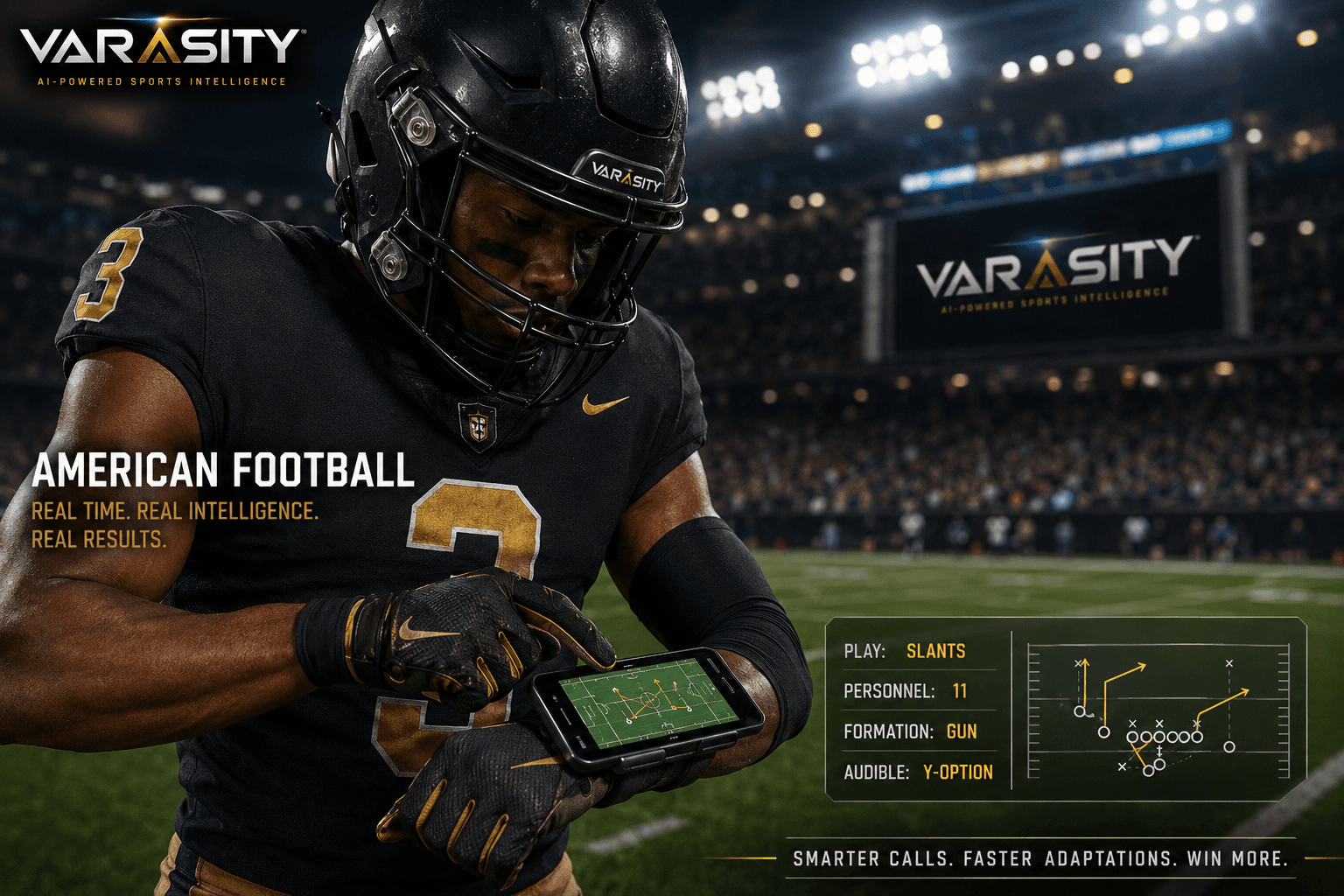
The Pipeline
From kinetic input to tactical HUD.
Kinetic Input
Positioning, velocity, posture and formation context captured by hardware partners and on-field sensors.
Neural Mapping
Proprietary neural architecture compares the live state against a sport-specific corpus of historical play data.
Tactical Synthesis
The system surfaces the highest-leverage adjustment for the moment — coverage, route, set-piece, rotation.
HUD Delivery
The cue lands on the athlete's wrist, helmet, or in the coach's tablet in under 20 milliseconds.
Multimodal Inputs
How athletes and coaches talk to the system.
Voice Commands
Coaches and players query the system hands-free during stoppages and dead-ball moments.
Visual Input
Camera and sensor feeds — from sideline rigs, drones, or league broadcast partners.
Text Input
Quick notes from coordinators get fused into the live model without breaking the flow.
AI-Powered Insights
The system surfaces patterns no human has time to track — fatigue spikes, tendency shifts, matchup edges.
Depth
Accelerate Athlete Playcall Awareness Development
Varasity Sports Intelligence is built on a published patent covering real-time neural network feedback systems for live athletic environments. Claims to the tehnology is published with the USPTO.